[I’ve been distracted lately (by undisclosed or at least only vaguely explained bullshit). In the interest of gradually and incrementally crawling out from under one of life’s necessary but annoying rocks, I’m making a low key post about a recent project. Go easy on me folks…]
In 2021, I went to the dark side. I bought a Dewalt electric chainsaw. I was embarrassed that it wasn’t a gas saw.
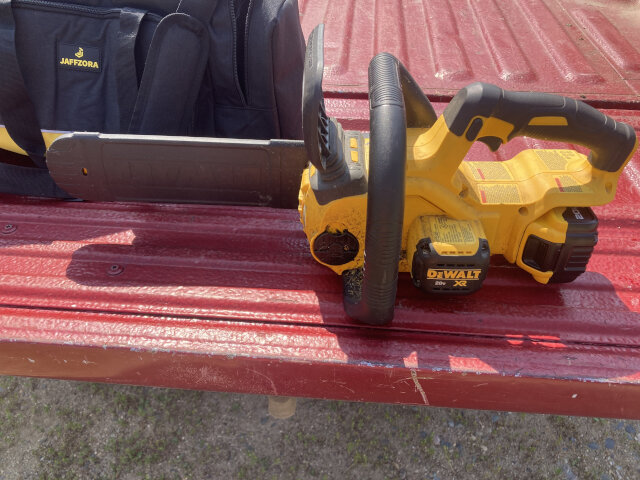
At the time, I considered battery powered saws to be whiny vegan nerd gadgets for doing half-assed, half jobs in nature-free suburbs. I might as well put on a tutu! But time changes and opinions must keep up with the energy density of batteries.
Also, there’s the matter of efficiency. My beefy two stroke saw is too much hassle for small jobs. I found myself unmotivated to lug gas and oil and yank start a roaring spastic death-saw for every ten minute job. Over time, the big saw seems to get fueled and started only when I’ll be working it several hours at least.
The little saw impresses me. It punches well above its weight class! I bought a pruning saw (I playfully call it “chainsaw on a stick”) too. However, a stick mounted micro saw is overspecialized. It works for its purpose but I don’t use it very much.
The little chainsaw is a winner. It bounces around in my tractor bucket while I’m doing other shit. If I encounter incidental limbs or whatnot, I grab it from the bucket and the little saw chews through stuff like a chihuahua on crack. Then I toss it back in the bucket to be ignored for days or weeks. Brilliant!
Also, it’s a camping BEAST! Trust me on this, if you “car camp” or as YouTube influencers say “overland” you need a little electric saw. A nearly silent little electric chainsaw can hack up an ass-load of campfire wood without pissing anyone off with the sound. It’s much faster than my old bow saw. Toss a little electric saw in your truck and you’ll never want for firewood again (barring legal shit like National Park campgrounds).
I flogged the little saw mercilessly. By 2024 I’d done no damage other than breaking the housing on one of my batteries (and I nuked a few chains). That’s about as reliable as one could ever hope. I’m impressed!
The battery broke from being tossed around in my tractor bucket, not from overwork.
I set out to buy a new battery at a local box store. I lost my shit over the price!
By Crom’s throbbing nutsack I’m not dropping a c-note on a battery the size of a potato!
The box store was stupidly expensive. I sought to buy a two pack of 20v 5 Amp Dewalt batteries from Amazon which wasn’t cheap but less of a kick in the nuts.
Then, as now, I noticed an anomaly:
Adding a charger reduces cost? WHY?!? It’s madness! It’s marketing gone beyond any semblance of logic! It’s an affront to economics, dignity, and the concept of reality… but it’s true. You’ll save $20 by buying two batteries AND a charger over the cost of just two batteries.
If anyone reading is from Dewalt… explain this to me. Use small words!
Last year I didn’t see generic non-Dewalt batteries. Now, in 2025, there are knockoffs. Dewalt deserves this for doing stupid shit like charging more for NOT getting a charger. The knock offs are cheaper and they look real close to the original… but I doubt it’s true. It’s like saying “this pill looks like that pill, I’m sure the chemicals are identical so I’ll take them”.
I’ve had bad luck with knock off batteries from China. They might be the same as name brand. They might not. YMMV.
On the other hand, I had no qualms about buying a cheap Chinese knock off “box” and cramming the still functioning Dewalt components in the box. Which is exactly what I did.
Check my post for a step by step guide. I yanked the Dewalt components out of the trashed housing and cramming them into a cheap knock off housing. It’s not rocket surgery.
The knock off housing (at the time) cost $12.32. It’s no longer listed and I don’t recommend it anyway. It was made of the shittiest plastic imaginable. If it was any flimsier it would have arrived as dust.
But it did work… for about a year. Last month I broke the housing. This time it broke everywhere.
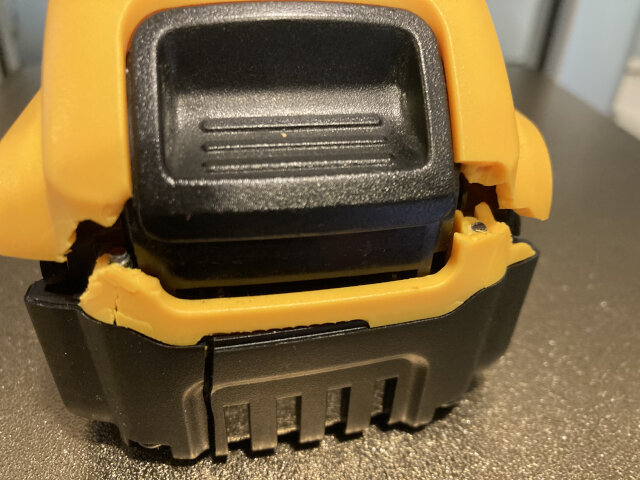
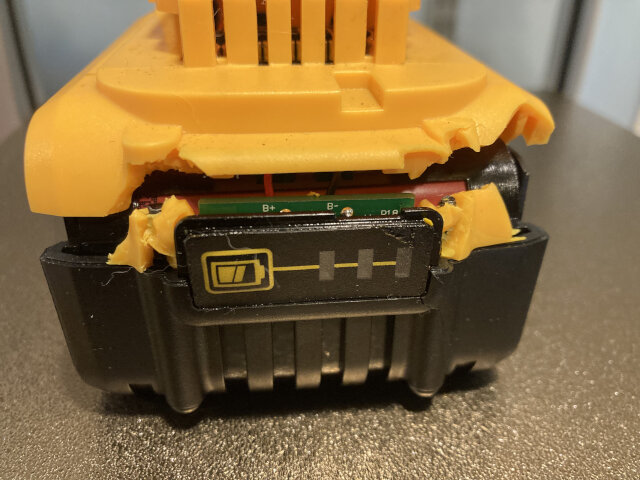
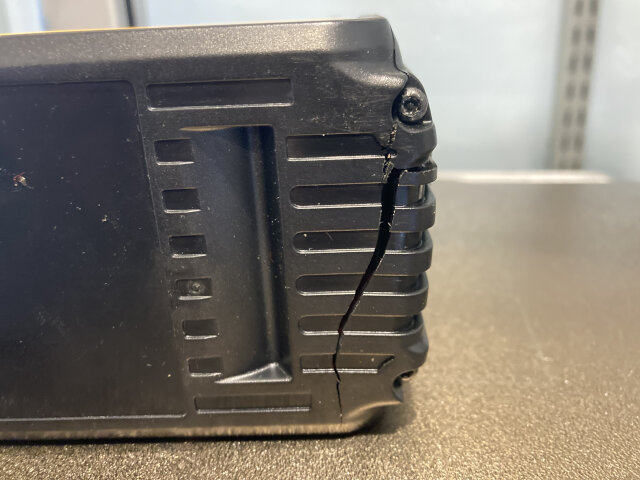
I fully expected cells themselves to wear down or the electronic board to short out. Not yet. I just broke the housing. I’m very impressed by what 20volts/5amp-hours can do.
Since it was broke, should I toss the battery cells? They’ve outlasted the OEM case and a rip off junker case, time to give up?
Hell no!
Last December I bought a 3d printer. I am officially a big bad maker of things.
First I tried to print a replacement following a free design I found on the ‘net somewhere. My only investment was a buck of filament and some time. Oh… and you need $500 worth of printer, filament switching hardware, filament, and the knowledge to use it. So it’s either “almost free” or “just over $500” depending on your point of view.
If that’s not an allegory for life I don’t know what is!
The free design sucked! I expected it to suck and printed it in cheap PLA just to see what would happen. The build looked ok but it cracked. I don’t mind. That’s why our language has the word “prototype”.
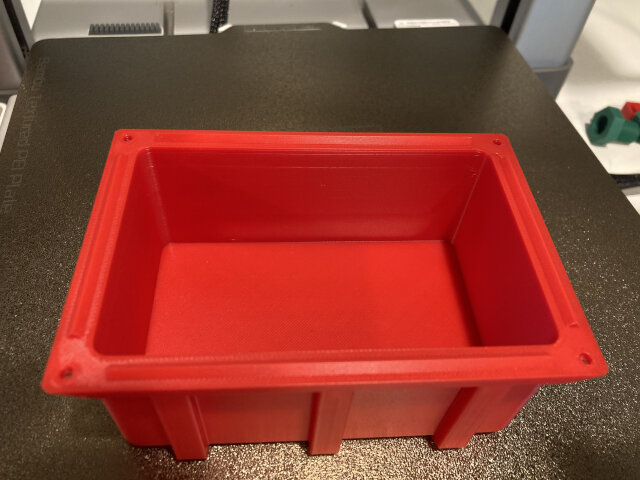
A broke “prototype” is just a lesson learned.
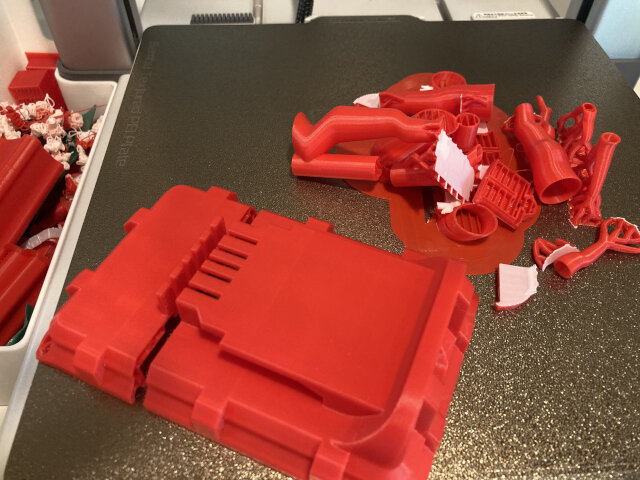
I could improve things by altering the slicer settings but there was a fatal flaw. The object I’d made didn’t fit right. That’s a deal killer! This housing design was close but inadequate.
I gave up and bought a more carefully made design.
Did you hear what I said? I paid money for information. Folks have been awash in bullshit so long they forget that true knowledge is worth real money.
Ponder where that leads us as a society. There are people with $50,000 in student loans debts over an education in “advanced navel gazing” with a return on investment of jack squat. Simultaneously online folks will fret over $15 for a 3d print model that’s exactly what they need.
Fifty large for bullshit or $15 for knowledge of value. Such choices abound.
I paid for knowledge that is useful and was happy to do so. Shouldn’t anyone?
I printed the new model using PETG filament. Without going into detail PETG is a step up from the simplest 3D printing filament (PLA). It only adds a few bucks per spool. It’s stronger, tougher, supposedly more resistant to temperature, and otherwise more awesome… but it’s still reasonably easy to use.
I have some exotic filaments. Carbon fiber infused PETG. TPU for AMS (which was lame). Real 95A TPU. Etc… I haven’t mastered those materials yet and don’t need them for a simple battery housing anyway.
I changed slicer settings too. I went to 100% infill. I altered orientation to make the least overhang but I also used supports. In retrospect I could have chosen a “stronger” orientation at the risk of more bullshit with supports. Life has trade offs.
The image below has a lot of nerd in it. The supports are hollow “trees”. The white stuff is PLA “interface” between the PETG object and the PETG support… meaning it breaks apart easily. The 100% infill consumes more filament but it seemed worthwhile on a thin object that’ll get used hard. The result seemed pretty tough.
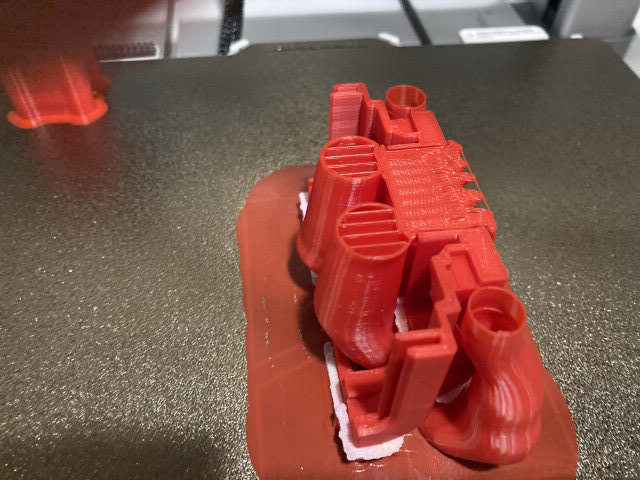
I chose stupid colors because I wanted to use up the last of a spool on the small half of the job. Also who gives a shit about colors on a chainsaw battery? Actually I do. After I started, I found a spool of PETG clear translucent… I wish I’d used that. A translucent battery housing would have looked cool.
I don’t know how much the filament cost. I’m guessing about $5 total? That includes the PLA sacrificed as a prototype.
Lastly I chose a design with through bolts instead of screws that grind into the housing. This differs from OEM and is almost certainly stronger.
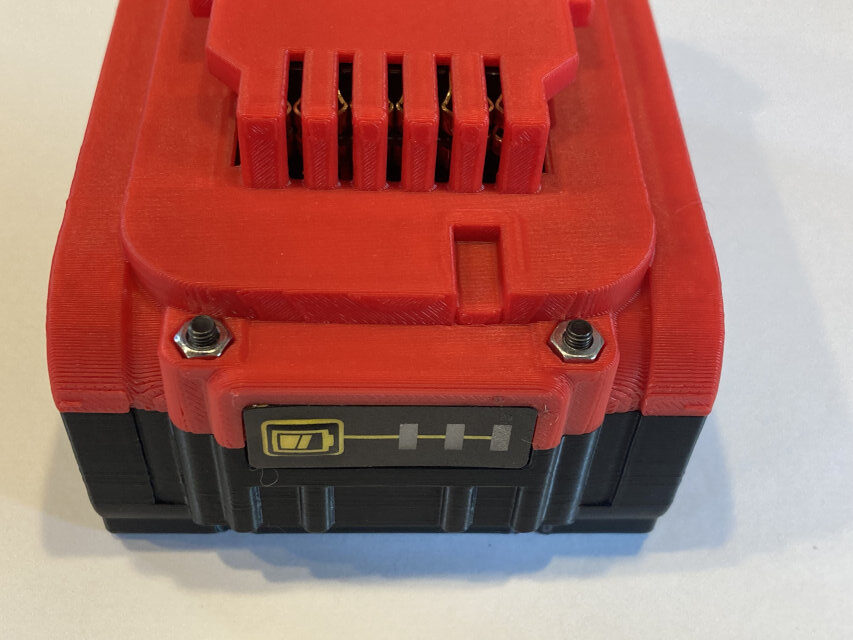
In the pictures you can see the 3d print lines. This is something generally minimized or avoided but it’s only cosmetic. It has nothing to do with the strength of a work tool.
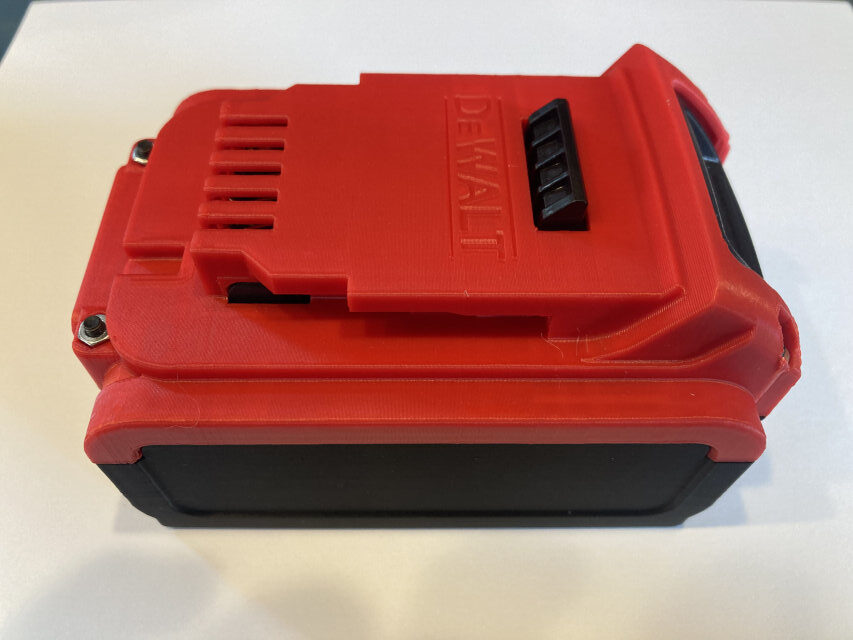
I have a shitload of tiny metric bolts for 3d printing and smugly assumed I’d be set. Alas, I had none of the right size. I paid $8 total for four bolts and four nuts and the little hex key at my local store. Considering the size of the tiny bolts, $8 is obscene! Then again it’s a miracle I found them for sale at the local hardware store. Also, I like to throw money their way. Just as I value knowledge, I value my local hardware store. They’ve been ever so helpful for years. They’ve earned the right to rake me over the coals if I want to buy obscure tiny metric threaded hardware on a Sunday.
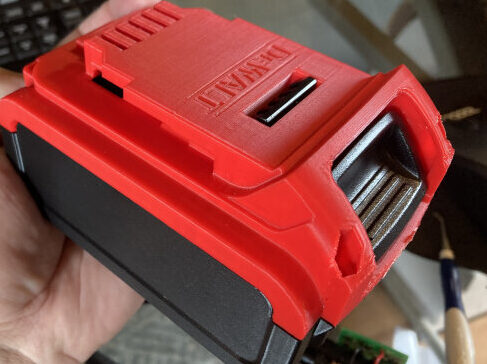
Final assembly was trivially easy. The results are better than the Chinese knock off housing, and (if you ignore the ugly colors I chose) it’s basically identical to the OEM product. When (not if but when) I break the next battery, I’m all set to “fix” that one too.
That’s my story and I’m sticking to it. Happy 3D printing y’all.


That was good, thanks. Supporting your local hardware store is a really good idea!
You’re welcome. Yeah, my hardware store has earned it’s reward from all the times I wandered in with some part and they actually knew what to sell me to fix it. A box store usually has hardly any brainpower available.
I like how Ron Swanson handles the big box stores.
Awesome fix.
Thanks.
Since the new housing is largely red, your chainsaw should go faster. Simple Orkish* science.
*Warhammer 40K Orks, of course.
Maybe my next chainsaw battery will have an homage to Bruce Campbell. I should emboss the word “groovy” on it!
Where the brand name is on the original housing, you could brand it “S-Mart.”
Absolutely!
I switched to electric saws when I got tired of gummed up two strokes. Never looked back. A small 2k generator lets me take the saw anywhere in the tractor bucket. Works every time, quiet. And this is FL where you need a saw every year from July to January. I don’t have the printer…still use Amazon for parts (rarely). Good on you to fabricate. Definitely a super power ( as long as you have power).
Speaking of the “superpower” of 3d printing needing electricity, it needs less juice than I expected. It varies depending on the printer itself and the temperature settings needed for specific filaments but it probably uses a lot less than a coffee pot. What surprised me was a cheap laser printer. Why do they need so much?
That is definitely cool. I want to get a 3- printer but I get lost as heck when I just go looking. There are a bewildering set of features all touted differently by each manufacturer, Any ideas on how I might wade through the flotsam and jetsam? I shall first go back and read your previous posts on the matter,
The entry point into 3d printers is a rabbit hole which can eat you alive! But you’re missing out on so much fun! I hate to see anyone miss the party! Here’s my advice (which you’re free to ignore):
0. Read my post here. I purchased a Bambulab A1 Combo. The link goes to Amazon. It’s on sale at Amazon ($90 coupon!). I bought mine last December and got a smoking hot deal which you probably can’t match. Sorry but I moved at an optimal time. It might be cheaper other places than Amazon or maybe not. Bambulab has since launched newer printers which might or might not be technically superior. You’ll have to sort that out yourself. My printer has kept me so entertained I don’t care about the newest gadget on the market. If (when?) you buy well, you won’t either. (BTW: If you buy anything from the Amazon link I get a few bucks and it costs you nothing.)
Anyway, for a flat out beginner I recommend Bambulab. I bought the A1 there is a printer called the A1-mini… the only difference is build envelope. If you’ll do only small stuff the mini is just as good… but you can’t ever upgrade build envelope. So I went big and I’m happy I did. With either printer you’ll have your first Benchy in mid-print within an hour of opening the box. It’s not the cheapest but I’ve run the A1 for 8 months and it has exceeded all my expectations; by a lot. I’m just blown away!
There are cheaper options that may print equal quality but only if you master a lot of esoteric shit. It’s worth it (if you’ve got the scratch) to pay for “ease of use”. If you can afford Bambulab, they’re perfect for most n00b users. I don’t feel like I’ll “grow out” of it. Online support is superlative. You can scroll though a million examples and literally click “send this to my printer” and it’ll work. (With some minor input from you.)
If you’re an experienced 3d printing wizard you could get by without all of Bambulab’s “user friendliness” but if so why are you reading my blog?
Here’s more info:
1. Don’t go overboard trying to “optimize”. There is no exact perfect printer that can do everything in all instances that’s cheaper than all other options and easier to use and will also brew you coffee. There are pros and cons to everything. Luckily we live in the future! The center of the bell curve (in 2025!) isn’t half bad. Overthinking will only run into your lack of knowledge and experience. You have no idea even which parts of the hobby will appeal to you anyway. The good news is many printers (in 2025) are “plenty good enough”. If what you buy has features aren’t the most awesome of everything on the market it won’t really matter at first; unless you go nuts it might never matter.
2. Ignore resin printers unless you want to make tiny art/jewelry or (more common) you want to make minifigs for your D&D game (and you’re cool with objects made with only one color/material). Resin is optimized for amazing detail on something small and single colored. Minifig people like painting stuff. (I hate painting stuff!). The drawback to resin is vats of… well… resin. It’s nasty chemical goo; a hassle you’ll be happy to avoid if you don’t need resin’s special properties. Don’t fret! You can make D&D minifigs on a regular 3D printer. They will be “average”. Resin will look slightly better only if you hold it up to a magnifying glass. Just how uptight are you anyway? If you’re a reasonable sort who wants more than small art pieces, go for filament over resin.
3. Ease of use matters. It’s worth paying a bit more to avoid the BS. Bambulab went all in on ease of use for the n00b (which annoys expert users). 3D is a rabbit hole that goes deep. I love nerd stuff but 3D printing is Alice in Wonderland deep. With my “n00b tolerant setup” I can occasionally say “fuck it, print everything in default”. The Bambulab A1 and it’s slicer software will usually do fine without me.
4. Things that switch between filaments (in my case it’s called the AMS lite) are worth it… almost required. They used to be rare and uncommon, now you just gotta’ have one. Think about electric windows in a car; cranks worked fine but would you buy a newly manufactured car that has one… and also lacks AC. Most filament switchers can run 4 colors or four different materials. You can run any 3D printer on one sole roll of filament you’re eventually going to want automatic switching… and very soon. Like when you want black tires and a silver hub on the jeep wheels you’re printing (just an example). Incidentally, the AMS Lite on the Bambulab A1 is about the dumbest looking filament switcher on the market. It works flawlessly but it looks stupid. Buy whatever AMS that goes with your printer. They have to talk to each other. You won’t save money buying it later.
5. More expensive printers are capable of more elaborate materials (usually due to an enclosure and maybe heating capacity). Don’t freak out. You’ll go nuts trying to pick out what materials you’ll use because it’s for projects you’ve never done using technology you don’t know. Unless you’re building something very special with specific materials (“it’s a kayak that works in space!”, “it’s a drone made of shit so light it makes NASA cry!”), you don’t need extreme materials. My printer has no enclosure and I haven’t fretted over it yet.
6. Some filaments (not PLA) need to be dried. Don’t fret too much over this. Dweebs on the ‘net will convince you that one molecule of H20 will destroy everything. I haven’t encountered that with the basic filaments I’ve been using. The drying thing is only for sensitive stuff a n00b won’t be using. Also filament dryers are cheap… about the cost of a toaster (I bought one and haven’t really needed it). As soon as you get a printer, you’ll soon learn the magic secret of storing your filament in “Tupperwear-ish” boxes filled with desiccant. We all do it. It’s fun and easy adapting the boxes. Desiccant storage boxes will solve 99% of your problems before they even happen; especially if you’re printing with PLA.
7. Start with easy to use filament; PLA. PLA is your friend. It’s forgiving and cheap. Suitable for indoor use, keychains, tchotchkes, toys, prototypes, and a million other things. You could print a thousand years with just PLA filament and never get bored. You don’t need a dryer for PLA.
8. PETG is the next step up after PLA, it’s much stronger and better for hard use. It’s roughly $2 more per spool… which isn’t much. You’ll almost never need a dryer for PETG. Transparent or tinted PETG is fun.
9. Buy Bambulab filament for your Bambulab printer to make your life easier. It’s only a little bit more expensive than the many other options on the market. A Bambulab AMS will also read a RFID on the Bambulab spool and set itself accordingly. If you’re a n00b take the easy path.
9.5. You can buy filament on the spool or buy a “refill” without the spool. (Saving a few bucks with the refill.) Buy your first several filaments on the spool. After that, it’s a matter of how cheap you feel like being. Spools are re-useable; especially if you stick with all one brand (like Bambulab). What if you need to use a refill (because it’s your favorite color?) but don’t have an empty spool hanging around to mount it? Just make a new spool! Use whatever you’ve got handy, PLA is fine. Using a 3d printer to make parts and additions and spare spools for itself is a rite of passage. Are you seeing how owning a 3D printer lets you think weirdly? I wish I could buy a car that makes its own tires!
10. TPU is the third level of filament. I’m still climbing that mountain. It costs a good 50% more than PLA but it’s squishy, bendy, and flexible. You’ll soon think of squishy things to make. Sneakers? Game balls? Hinges? Wallets? A Halloween facemask? Wearable stuff? Bambulab makes “TPU for AMS”. It sucks. My AMS lite, which came with the A1 printer, can’t do TPU. No sweat! I can bypass the AMS as needed. I bought a real spool of 95A TPU but haven’t used it yet.
11. There’s a 90% chance you’ll never go past PLA and a 99% chance you won’t exceed PETG. Only weirdos like me even think about fiddling with TPU. Don’t lose sleep worrying about a printer that can’t easily print nylon or ABS or whatnot. Unless you specifically have a reason to need it, you won’t. If you want to make hot rod exhaust manifolds that can handle a zillion degrees or aerospace materials that’ll survive in space you might have to get a more expensive machine. Cross that bridge when you get to it.
12. No matter how much filament you buy, you’ll want more. But you won’t know what you want until you’ve tinkered a bit. Buy at least 3 spools of filament (or more) when you start. Start with PLA in various crayon-ish colors and/or black and white. Then after the initial wave crashes over you, you’ll know what you really want. Filament comes in every color you can imagine. It can be matte, glossy, silky, reflective, perfectly match that special military camo only used in Belgium in 1976, have reflective flakes like a 1970’s fiberglass paint job, look like marble, come in pastels, include carbon fiber for strength (in every color of course), a sort of tie-died spectrum on the same strand (like certain knitting yarns), glow in the dark, transparent (truly clear takes some doing), translucent tints, etc… Buy more spools of filament as you learn. It’s like Christmas every time a new spool arrives! You will soon amass a collection of your favorite types of that sweet sweet filament.
13. This is the last and most important thing; once you master 3d printing (it’ll take a while) you’ll think differently. This is unavoidable. You’ll have become someone who can create damn near any physical object (at least those made of certain materials.) Everyone else must choose things like soap dishes, door stops, a matchbox car, a box lid, a handle, a camper’s match case from among the objects at the store. Not you! You’ll think “I can make that cheaper and better and more awesome”. You’ll eventually see damn near everything (at least things made of plastic) as something that you could potentially make for $15 a kilogram… in your favorite color… and better. (And a kilogram of filament goes a long way.) This is the same thinking that happens to a welder, or a carpenter, or a machinist, or a seamstress, or a mason. That’s why it’s awesome to live right now instead of 30 years ago when these devices were literally science fiction.
Come on in… the water’s fine!
There is so much good info there I had to cut and paste it into a document so I don’t miss anything and can read it as I go along on my trek. Thanks a bunch, I think you’ve cleared a lot of the minefield ahead of me. Much Appreciated!
Glad to help. Good luck.
Where I live, the electric pole saw sees more use than the standard chainsaw. I own both, but the extremely spiny growth needing pruning is much easier to cut away with little blood than a chainsaw. But I do take your point – anything over 4″ in diameter is better cut with the longer bar.
I’m not up to 3D printing yet, but I hear it opens up your horizons.
It opens up all sorts of options but it also makes you into a total nerd (I was already a nerd). Nobody sane cares about how you changed the slicer’s support settings to make that cool lamp housing… but 3d people find it fascinating.
Great tutorial! Now, I need one. You did this to me!
There’s no going back. 🙂
Except getting it past the CFO might be challenging…….
I’m a CNC metal subtractive person right now….in between heat it and beat it forging or brutally stamp a piece off/out or mangle the former thing into the latter thing. However, the additive manufacturing thing once was my thing, and still is from time to time.
It must be possible to 3D print a thing, and then overlay it with a fabric and then impregnate it with a powerful adhesive, perhaps in layers, and then push another printed 3D thing onto it, perhaps with overlaid membranes and under application of pressure relatively negative to atmospheric, and even bake the thing-to-be with heat or UV.
The 3D printing gig looks very interesting. Does one write ones own code or scan the desired thing and tweak?
Stefan “eager to hear of boat” v.
I don’t have a scanner and haven’t had the best luck with scanned files. I’ve had surprisingly good luck with taking measurements and then drafting the geometry of the object straight out. I use Fusion 360 but there are several equally good 3d modeling programs. I’m still a novice so my models are fairly simple I can see how handy it is. Also it’s pretty neat starting with nothing but an idea and ending up with a physical object. I also search through makerworld and find pre-made models. No use reinventing the wheel if I don’t have to. Many online models (even the free ones) are damn good.
I’m 100% sure you could 3d print an object and apply an overlay. Slapping a layer of fiberglass over a 3d printed base seems logical (though I’m not sure which resins would adhere to which filaments.
I have never needed to write G-code. The slicer handles it for me.
Pushing one 3d object into another and fusing them together seems weird. You can make literally any shape so I’d lean toward simply merging the objects in software and then printing all at once.
And then there is 3d printing on steroids:
https://www.massivit3d.com/large-3d-printers/massivit-5000/
I’m impressed by the industrial applications, but then again I just assumed industry would lead the way with additive. How could they not?
I’m a little disappointed that 3d printing of structures has not yet hit its stride. I always daydreamed I’d have some sort of homestead scaled device that could crank out wood sheds and chicken coops from extruded concrete-ish something. Thus avoiding the bullshit fitting and tinkery carpentry of a house. I imagined a center-pivot cement laying machine making beehive-ish architecture. Maybe a hunting cabin or something. Alas, while a home sized sawmill is possible, a home sized “shed and barn generator” is not yet available.
Oh, and one last thing. I’m crossing the bridge into 3D prints with electronics… using the baby-steps toy and training platform of Bambulab Cyberbrick. You might want to check it out. Cyberbrick is new and it was sold out until just a few weeks ago. I’ll post when (if?) I create something out of my box of random electronics and gears.
I use a battery powered Sawzall as my limited duty chain saw without a chain.