[If you know the details of 3d printing, you’ll instantly know where this story is going. I present it here for the entertainment of people who don’t already know.]
“There are three kinds of men. The one that learns by reading. The few who learn by observation. The rest of them have to pee on the electric fence for themselves.” – Will Rogers
One of the cool things about 3d printing is that you can make (within reason) anything. However, it’s not always apparent (especially to a rookie) why you shouldn’t make object X with material Y under conditions Z.
You don’t know what you don’t know.
A year ago, when I first bought my 3d printer, I bought enough filament to get started. You can buy filament on spools or refills (basically a little cardboard tube that looks like a TP tube). The refills slide onto spools that you already own. You save a few bucks when you buy a refill.
Being the cheap bastard I am, I bought just barely enough spools to get rolling. I used some spool mounted filament to print more spools for the refills I’d cheaply bought. What a neat concept! You can print stuff for your printer with the printer itself. That never gets old.
The spool I’d printed was made of the simplest and easiest to use filament; PLA. PLA is fine for many uses but it’s not great at handling high temperatures.
Eventually I stepped up to PETG. It’s a bit more annoying to work with but it’s stronger and tougher and resists higher temperatures. Unlike PLA it should be dried in a little filament “oven” before you use it. I limped along with desiccant and luck for a while, but in due time I saw the light and bought a filament dryer. (Dry filament makes a better finished print.) My drier has settings for whatever material you’re using. I can set it for PLA or PETG or TPU or any of several other materials.
Over time, I occasionally bought filament on spools (particularly when refills in the color I want are sold out). Once they’re empty they’re perfect to hold the next refill. Thus, I never needed to print another “DIY” spool.
Monday, a box of filament came in. As usual I’d purchased mostly refills. I scooped up a refill of yellow PETG but the only spare spool I had was the old DIY one from last year. Any port in a storm. Into the dryer it went.
Did you notice where I messed up?
An hour later I saw this:


Whoops! Heating a spool made of PLA at PETG’s higher drying temperatures was unwise! In retrospect I can’t believe I did that. Luckily, I caught it in time and the filament looks undamaged. Whew. (The spool is toast but that’s no big deal.)
While I’d been faffing about with the dryer, my printer had been running. By chance it had used up a different spool. Thus, a factory empty spool was available. I remounted the refill on the commercial spool and all was well.
I can’t blame anyone but myself. The factory spool has its temperature range clearly displayed.


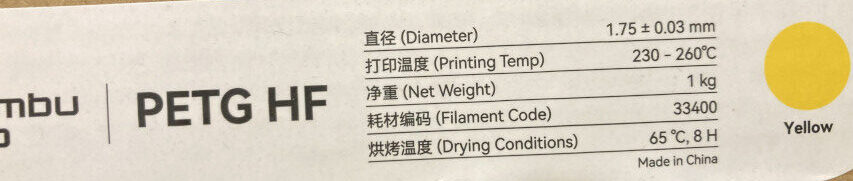
The PETG refill has its drying temperature clearly displayed too.

Chalk it up as a learning experience.